The plain answer
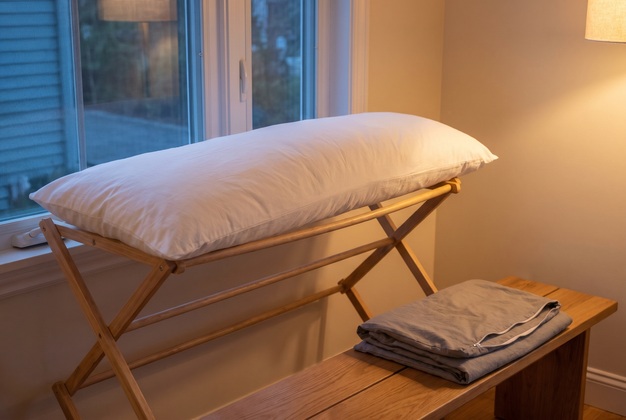
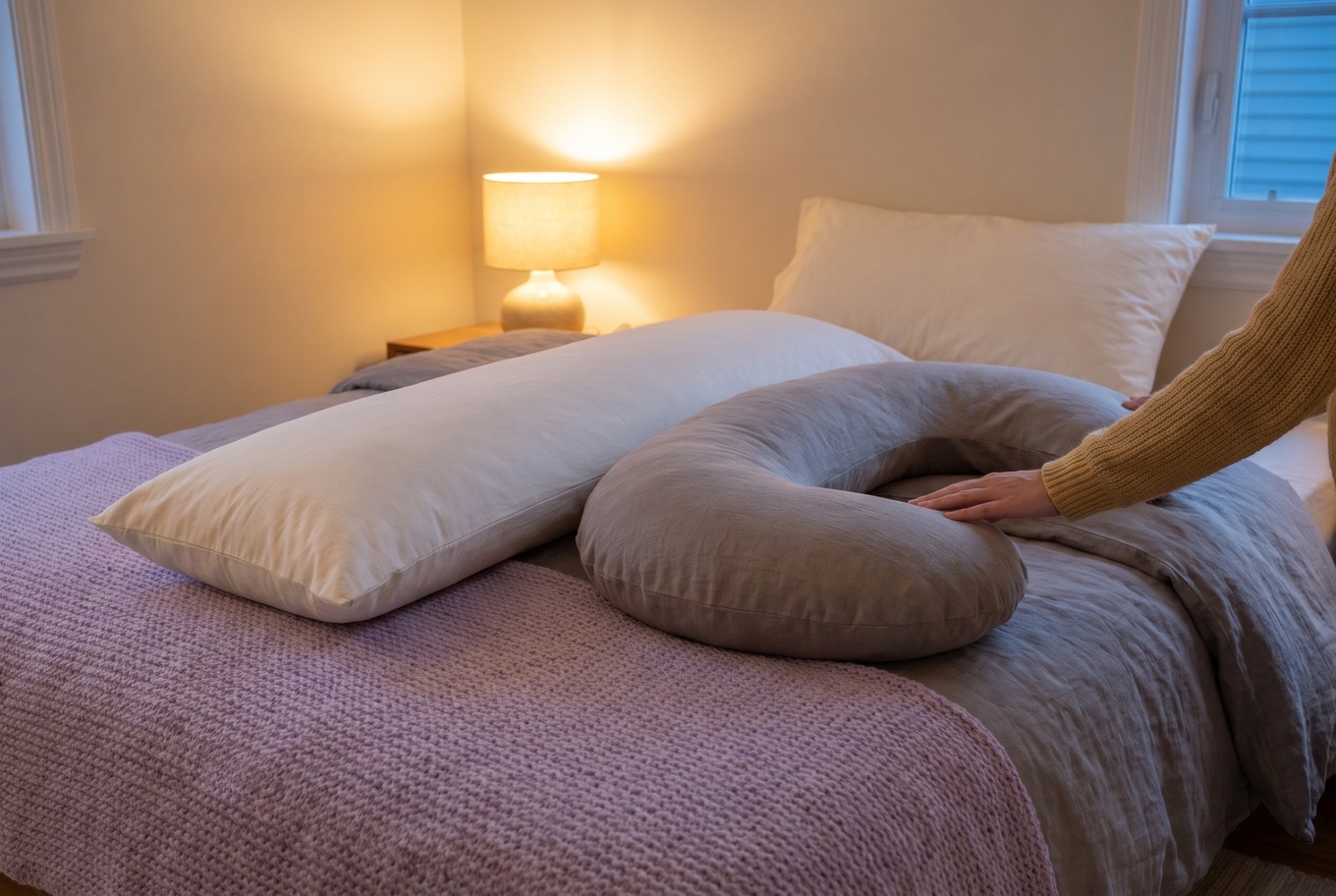
A body pillow fills two gaps. Between your knees, it holds your top thigh level with your hip, so the pelvis does not roll forward and twist the lower back. Under your top arm, it stops your shoulder slumping across your chest. The common US size of 20 by 54 inches is long enough to do both at once (Walmart). Curved C and U shapes add a wall behind the back. You know the firmness is right when your knees stay stacked.
This guide is for: side sleepers who wake with a stiff hip, low back or neck, and anyone curious how a long pillow changes the way the body lies at night.
Key Takeaways
Three points from the research and our page count that explain most of how a body pillow works, each with the figure behind it and a link to its source.
- Side is the main sleep position: adults in one sensor study spent 54.1% of their time in bed on their side (Skarpsno et al.).
- The common US size is 20 by 54 inches, about two 20 by 26 inch bed pillows end to end, which is long enough to hold the top arm and the knees at once (Walmart).
- Fill is often unstated: we read 11 seller product pages on September 25, 2026. Of those, 2 gave a weight in ounces or pounds, 5 named the fill without a weight, and 4 named neither.
Why do side sleepers use a body pillow at all?
Side sleeping leaves your top arm and top leg with nothing to rest on, and a body pillow gives both a place to go so your spine stays level.
Side sleeping has a limb problem. Your top knee drifts forward and down, the pelvis rolls with it, and the lower back holds a slight twist for hours. The top arm does the same at the shoulder. It pulls your chest forward and rounds the upper back. A body pillow is long enough to catch both at once. You hug the upper end and hold the lower end between your knees.
Side sleeping is the norm, so this problem is common. The Danish sensor study found that time on the side rose with age and body weight, and time on the back fell to match (Skarpsno et al.). People also shifted position through the night. You will turn too. A pillow that moves with the sleeper, or sits within reach on either side, earns its place on the bed.
A pair of ordinary pillows can do part of this job. One between the knees handles the hips, and one to hug handles the shoulder. The case for one long pillow is that it stays in one piece during a turn, so you are not hunting for pillows in the dark. If you have never used one, our page on what a body pillow is explains the basic shapes and names.
What does a body pillow do for your hips and back?
It keeps your knees apart and your top leg level with your hip, which stops the slow twist that some people wake up feeling in the neck or back.
The American College of Obstetricians and Gynecologists gives the plainest version of the advice. It says to sleep on the side, keep one or both knees bent, and try a pillow between the knees or a full-length body pillow (ACOG). That page is written for pregnancy. The mechanics hold for you either way. The pillow sets the distance between your knees, and that distance decides whether your top thigh runs level or slopes toward the mattress.
The posture research is thin. One Australian study filmed fifty-three people while they slept and classed each posture as supportive or provocative (Cary et al., PLOS One). A published correction to its abstract gives the medians (PLOS One correction). People who woke with neck symptoms spent more than twice as long in provocative postures as people without symptoms. Neck symptoms showed the clearer link. The low back group did not differ significantly from the controls.
The study shows an association. It is not proof that a pillow fixes pain. What it supports is modest: fewer hours in a twisted position may help people who already wake stiff. A body pillow is a cheap way to test that at home. If your pain lasts, or began with an injury, see a clinician before you buy anything.
How do straight, C and U shapes hold a side sleeper differently?
A straight pillow holds the knees and the top arm. A C or U shape adds a wall at the back but takes more of the bed and more effort to turn.
Shape decides three things: which parts of you get support, how you turn over, and how much of the bed you give up. The table below is our judgement, built from the sizes on seller pages. No maker publishes this comparison. The pillows we pick were bought and handled, but none was measured for this table.
| Shape | Example size on a US seller page | What it supports | Turning over | Our judgement (not a maker's claim) |
|---|---|---|---|---|
| Straight | 20 x 54 in (Walmart) | Knees, arms, chest | It comes over with the sleeper | Default for most side sleepers; takes the least room |
| C-shaped | 57 x 30 in (Amazon) | Head, belly, knees, and one side of the back | Lifted and flipped to face the other way | Good for people who roll onto their back |
| U-shaped | 34 x 61 in (Macy's) | Both sides and the back at once | Stays put; the sleeper turns within it | Most support and most bed space; hard to share a small bed |
For someone who sleeps on one side and shares a bed, a straight pillow covers the knee and arm gaps in the least room. A curved pillow earns its extra size when rolling onto your back is the problem. That is common in late pregnancy. A C shape sits between the two. It wraps the front and one side of the back. To turn over, you flip it. A U shape stays put while you turn inside it. The cost is width.
What size body pillow fits an American bed?
A straight body pillow fits a standard case and is about as long as two bed pillows. Curved pillows run longer, so check your bed width.
The straight size seen most often in US listings is 20 by 54 inches, and cases are sold cut to it (DOWNSTORIA case, Amazon). A standard bed pillow is 20 by 26 inches (PillowsXpress). A body pillow is roughly two bed pillows end to end. That makes it easy to picture on a bed.
Curved pillows vary far more. The largest U shape we read is far longer than a straight pillow (Macy's), and the smallest is sized for shorter adults, according to its seller (Walmart). Match the length to body height. On a pillow that is too short, your feet end up past the end. Your knees then lose their gap.
A heavy pillow is harder to shift at night. The heaviest listed weight in our count belongs to a U-shaped pillow (Kohl's). A straight pillow is easier to lift across the body during a turn. Measure before you order a curved one. If the pillow is wider than half the bed, one sleeper will end up on its edge.
How do the common fills behave inside a body pillow?
Polyester fiberfill is light and keeps one height, shredded foam can be made higher or lower, and down alternative and feather hold more softly.
The fill decides how your pillow feels, how it washes, and whether you can change its thickness. That thickness sets your knee gap.
Polyester fiberfill is the usual default. One Walmart pillow names polyester fiberfill and gives its weight (Walmart). With shredded memory foam, you can make it higher or lower. Coop says its body pillows are adjustable so you can make them soft and fluffy, or firm (Amazon, Coop Home Goods). Down alternative aims for a squeezable feel. The Sleep Foundation describes one fill made of down alternative clusters derived from recycled plastic bottles (Sleep Foundation). Feather and down is less common. It is soft and easy to shape.
| Fill | What a seller's page states | How it holds the knee gap (our judgement) |
|---|---|---|
| Polyester fiberfill | Fill weight stated, spot clean only (Walmart) | Light and simple; the height is fixed |
| Shredded memory foam | CertiPUR-US certified foam, shipped vacuum packed (Amazon) | Firmer, and the height can be changed |
| Down alternative clusters | Clusters made from recycled bottles (Sleep Foundation) | Soft and squeezable; gives way more under a leg |
| Feather and down | Goose down and feather, 74 oz fill weight stated (Walmart, Pillowtex) | Soft and shapeable; needs a lot of fill to stay thick |
Washing differs by fill as much as feel does. A fiberfill insert may be spot clean only. Some foam pillows go in the machine whole. So read the care label as part of how your fill will behave over a year.
What do sellers tell you about the fill inside?
Most of the seller pages we read named a fill or nothing at all. Few gave a weight, and weight is the closest thing you get to a firmness figure.
We read 11 US seller product pages for straight, C-shaped and U-shaped body pillows on September 25, 2026, and counted what each said about its fill. We counted only the page text and did not weigh, handle or test any pillow. The pages fell into three groups: 2 gave a weight in ounces or pounds, 5 named the fill material without a weight, and 4 named neither in the text we could read. Our method page explains how we choose and count pages.
| What the page said | Pages | Pages in this group |
|---|---|---|
| Gave a weight in ounces or pounds | 2 | 38 oz of polyester fiberfill in a 20 x 54 in pillow (Mainstays, Walmart); 7.6 lbs for a 60-inch U shape, given for the whole pillow (Kohl's) |
| Named the fill, gave no weight | 5 | Polyester (a second Mainstays listing on Walmart, page since taken down; DOWNCOOL, Amazon, Utopia Bedding, Amazon, 1 MIDDLE ONE, Amazon); polyester and cotton (TOPCHANCES, Walmart) |
| Named neither | 4 | Size, cover or shape only (Yalamila, Walmart, AllerEase, Macy's, Regalo U-shaped, Regalo C-shaped) |
In our judgement, fill weight is the closest thing to a firmness figure you will get from a listing. Two pillows of the same size and fiber can feel very different. It depends on the amount inside. Some pages give no weight. Then the reviews help, with words like flat or firm. Nine natural-fill pillows, with what each maker prints about its fill, are set out in the natural body pillow picks.
How firm does a body pillow need to be to hold the knee gap?
Firm enough that your top knee stays level with your hip when you clamp the pillow, and soft enough that you can still bend it to hug the top end.

None of the seller pages we read gave firmness as a number. Your own body is the gauge. Lie on your side with the pillow between your knees. Your top thigh should run roughly parallel to the mattress, with the knees stacked. If your top knee still drops below your hip, the pillow is too thin or too soft. If your hips feel pushed open, it is too thick.
Body shape changes the answer. Broader hips need a thicker gap than a narrow frame, which is why one fixed pillow cannot suit everyone. Some pillows let the owner set the height. One C-shaped pillow has an inner zipper so you can take fill out or put it back (Amazon). That helps people whose hips are wider or narrower than average.
The upper half has a different job. You hug it, so it needs to bend around your arm without folding flat. A pillow that holds the knee gap but is too stiff to hug will push the shoulder back and open the chest. With fixed fill, choose for your knees. Stopping the hip twist is the main purpose, and the shoulder can make do with a softer hug.
When is a regular pillow between your knees enough?
If you sleep on one side, rarely turn and only need your knees apart, a firm bed pillow does much of what a body pillow does for far less money.
If you sleep on one side and rarely turn, a firm pillow you already own can sit between your knees. ACOG's back pain page suggests a pillow between the knees and another under the belly, and lists a full-length body pillow as one more option (ACOG). You do not need a special shape to get the knee gap right. You need the right thickness.
A body pillow earns its place in three situations. The first is frequent turning, when separate pillows get lost in the night. The second is an aching top shoulder that wants something to hug as well. The third is late pregnancy, when a long pillow at the back helps a sleeper settle on the side and stay there.
Try the free version first. Fold a pillow between your knees for several nights and note how your hip and back feel each morning. If nothing changes, a bigger pillow may not change it either. If the folded pillow helps but keeps escaping, that is your case for a body pillow. People shopping for a side-sleeper body pillow often skip this step, even though it costs nothing.
When should a body pillow stay out of the bed?
Never in a baby's sleep space: pediatric guidance keeps pillows and other soft items out of an infant's crib, bassinet or shared bed.
Never put a body pillow where a baby sleeps. The AAP says to keep loose blankets, pillows, stuffed toys, bumpers and other soft items out of the sleep space (AAP). Thousands of US infants die in sleep-related deaths each year, and soft bedding such as pillows is a risk factor that can be changed (CDC, via PMC).
This matters most in the months after a birth, when a pregnancy pillow is often still on the bed. If you might fall asleep with your baby in your bed, make sure no pillow could cover the baby's face, head and neck (HealthyChildren.org). Long pillows are exactly that risk. Don't use one as a barrier to stop a baby rolling off your bed, either.
Some adults should also take care. After hip surgery, follow your surgeon's rules on positioning first, since they may want a particular support rather than a soft pillow. If turning over in bed is hard for you, a bulky pillow gets in the way. Most other adults face little risk. The main cost is bed space, so check that whoever shares your bed is happy with that.
Common questions
Short answers to the questions side sleepers ask most often about living with a body pillow, with the source for each figure.
Is a body pillow good for side sleepers with hip pain?
It can help when the pain comes from the top leg dropping and twisting the pelvis. Keep your top thigh level with your hip and the knees stacked. The evidence linking posture to pain is observational, so treat the pillow as a trial rather than a treatment (Cary et al., PLOS One). See a clinician if the pain persists.
Where does a body pillow go in bed?
Along the front of the body, with the top arm and top knee resting on it and the lower end held between the knees and ankles. Some people add a second pillow behind the back to slow a roll onto it (Allina Health).
Why does a new body pillow look flat?
Most arrive vacuum packed for shipping. Give it a day or two, then push the ends in toward the middle to fluff it. If it still looks thin, check the listing for a fill weight, the nearest figure a page gives to how full a pillow is.
Can two people share a bed with a U-shaped pillow?
They can, but a U shape takes width on both sides of the sleeper. The largest one we read spreads well beyond a single sleeper's body (Macy's). Measure first. A straight or C-shaped pillow usually leaves a partner more room.
What size case fits a body pillow?
Most straight body pillows sold in the US share one common size, and cases are sold cut to it (DOWNSTORIA case, Amazon). Curved pregnancy pillows vary in shape. Check that a spare cover for that model is sold before buying.
How do you tell if a body pillow is too thick?
Lie on one side with it between the knees. If your hips feel pushed open, or the top knee sits higher than the hip, it is too thick. If the knee drops below the hip, it is too thin. Pillows with an inner zipper allow fill removal until the gap is right (Amazon).
Readers whose shape check ends this way are given a straight body pillow, and the length that suits your height.
Sources
Gathered here, the outside pages this body pillow guide quotes, each beside the part of the guide that needed it.
- Skarpsno et al., Nature and Science of Sleep (pubmed.ncbi.nlm.nih.gov), needed in “Key Takeaways”; “Why do side sleepers use a body pillow at all?”.
- Walmart (walmart.com), needed in “Key Takeaways”; “How do straight, C and U shapes hold a side sleeper differently?”; “How do the common fills behave inside a body pillow?”; “What do sellers tell you about the fill inside?”.
- ACOG (acog.org), needed in “What does a body pillow do for your hips and back?”; “When is a regular pillow between your knees enough?”.
- Cary et al., PLOS One (journals.plos.org), needed in “What does a body pillow do for your hips and back?”; “Common questions”.
- PLOS One correction (journals.plos.org), needed in “What does a body pillow do for your hips and back?”.
- Amazon (amazon.com), needed in “How do straight, C and U shapes hold a side sleeper differently?”; “What do sellers tell you about the fill inside?”; “How firm does a body pillow need to be to hold the knee gap?”; “Common questions”.
- Macy's (macys.com), needed in “How do straight, C and U shapes hold a side sleeper differently?”; “What size body pillow fits an American bed?”; “What do sellers tell you about the fill inside?”; “Common questions”.
- DOWNSTORIA case, Amazon (amazon.com), needed in “What size body pillow fits an American bed?”; “Common questions”.
- PillowsXpress (pillowsxpress.com), needed in “What size body pillow fits an American bed?”.
- Walmart (walmart.com), needed in “What size body pillow fits an American bed?”; “What do sellers tell you about the fill inside?”.
- Kohl's (kohls.com), needed in “What size body pillow fits an American bed?”; “What do sellers tell you about the fill inside?”.
- Amazon, Coop Home Goods (amazon.com), needed in “How do the common fills behave inside a body pillow?”.
- Sleep Foundation (sleepfoundation.org), needed in “How do the common fills behave inside a body pillow?”.
- Amazon (amazon.com), needed in “How do the common fills behave inside a body pillow?”.
- Walmart, Pillowtex (walmart.com), needed in “How do the common fills behave inside a body pillow?”.
- DOWNCOOL, Amazon (amazon.com), needed in “What do sellers tell you about the fill inside?”.
- Utopia Bedding, Amazon (amazon.com), needed in “What do sellers tell you about the fill inside?”.
- Yalamila, Walmart (walmart.com), needed in “What do sellers tell you about the fill inside?”.
- Regalo U-shaped (regalo-baby.com), needed in “What do sellers tell you about the fill inside?”.
- Regalo C-shaped (regalo-baby.com), needed in “What do sellers tell you about the fill inside?”.
- AAP (aap.org), needed in “When should a body pillow stay out of the bed?”.
- CDC, via PMC (ncbi.nlm.nih.gov), needed in “When should a body pillow stay out of the bed?”.
- HealthyChildren.org (healthychildren.org), needed in “When should a body pillow stay out of the bed?”.
- Allina Health (account.allinahealth.org), needed in “Common questions”.